A Mac app for video editors

Raw footage to a rough cut in your channel's style.

Point Sift at a card dump from every camera and recorder. It sorts the clips by device, syncs them onto one timeline, transcribes, finds the moments, and builds a rough cut that follows the structure and pacing of the channel you give it. Then it hands Premiere Pro an organized project.

Apple silicon · macOS 13+ · your own OpenRouter or Anthropic key

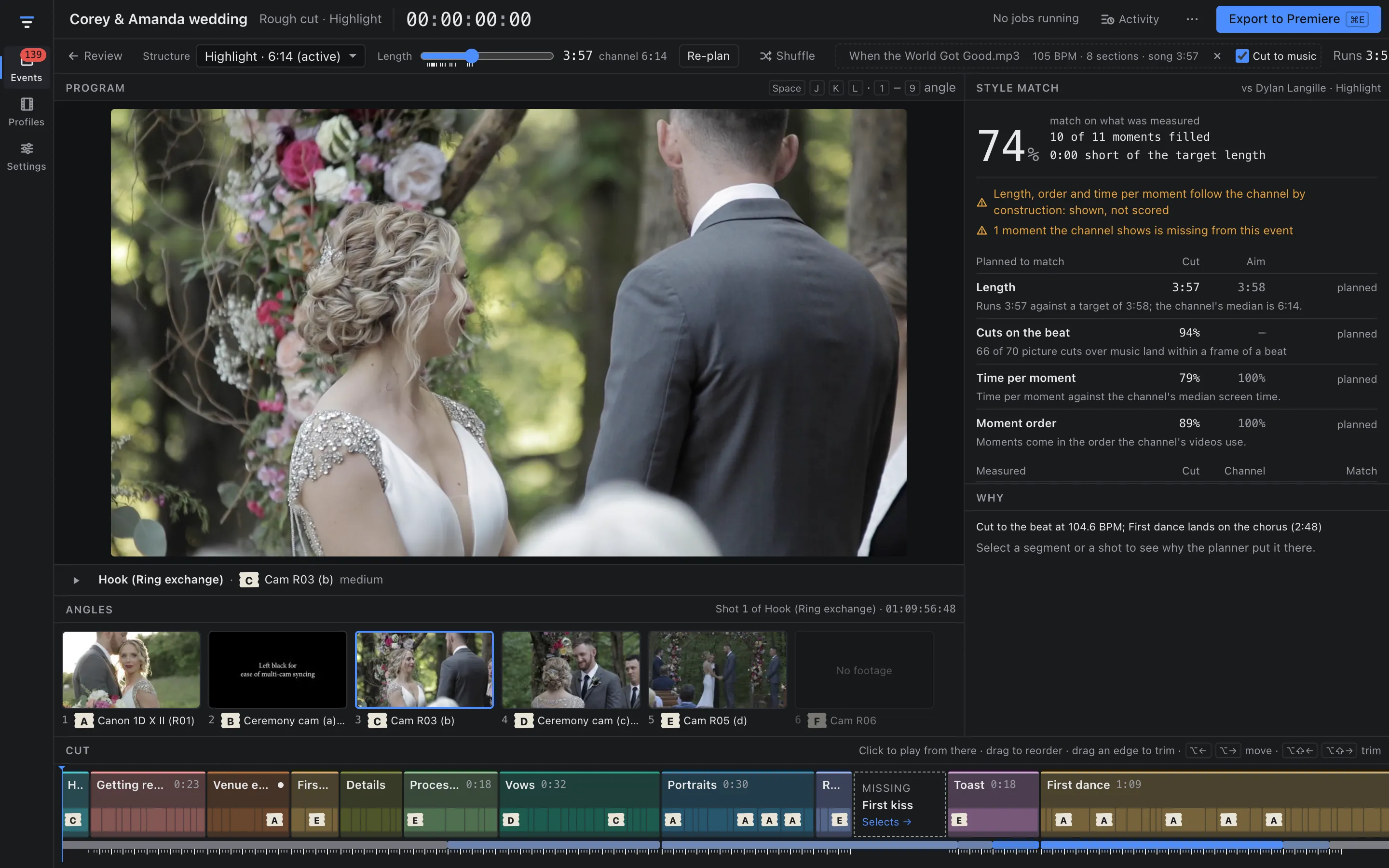
Sift's Rough cut screen for a wedding. The program monitor shows the bride and groom at the ceremony. Below it, an angle grid of six cameras and the cut: segments for getting ready, venue, first look, details, processional, vows, portraits, toast and first dance. The style match panel reads 74 percent and 'Cuts on the beat: 66 of 70 picture cuts over music land within a frame of a beat'.
Rough cutA wedding with 7 devices and 436 files, cut to a 3:57 song at 105 BPM. 66 of 70 cuts land on a beat.

How it works

Five steps from card to cut.

  1. Step 1: Point it at the card dump

    Choose the folder. Sift reads every clip and sorts it by camera and recorder, from metadata, reel names and folders. You check the devices board and confirm.

  2. Step 2: Profile a channel

    Paste a YouTube channel and pick the videos to learn from. Sift measures their structure, pacing, shot mix and sound.

  3. Step 3: Work Review to zero

    Sift syncs everything onto one timeline, transcribes it and finds the moments. Review is one count of what needs you before export.

  4. Step 4: Plan the rough cut

    A cut in that channel's style, from your footage. Trim, lock, swap angles, reorder, or cut it to a song.

  5. Step 5: Open it in Premiere

    One XML with the rough cut, a master timeline, Selects, synced sequences and every moment's candidates, in bins.

For scale: a 436-file wedding (about 11 GB from six cameras and a Zoom recorder) ran start to finish in about half an hour on a 10-core Mac. Review and the rough cut open as soon as it finishes.

Review

One count, down to zero.

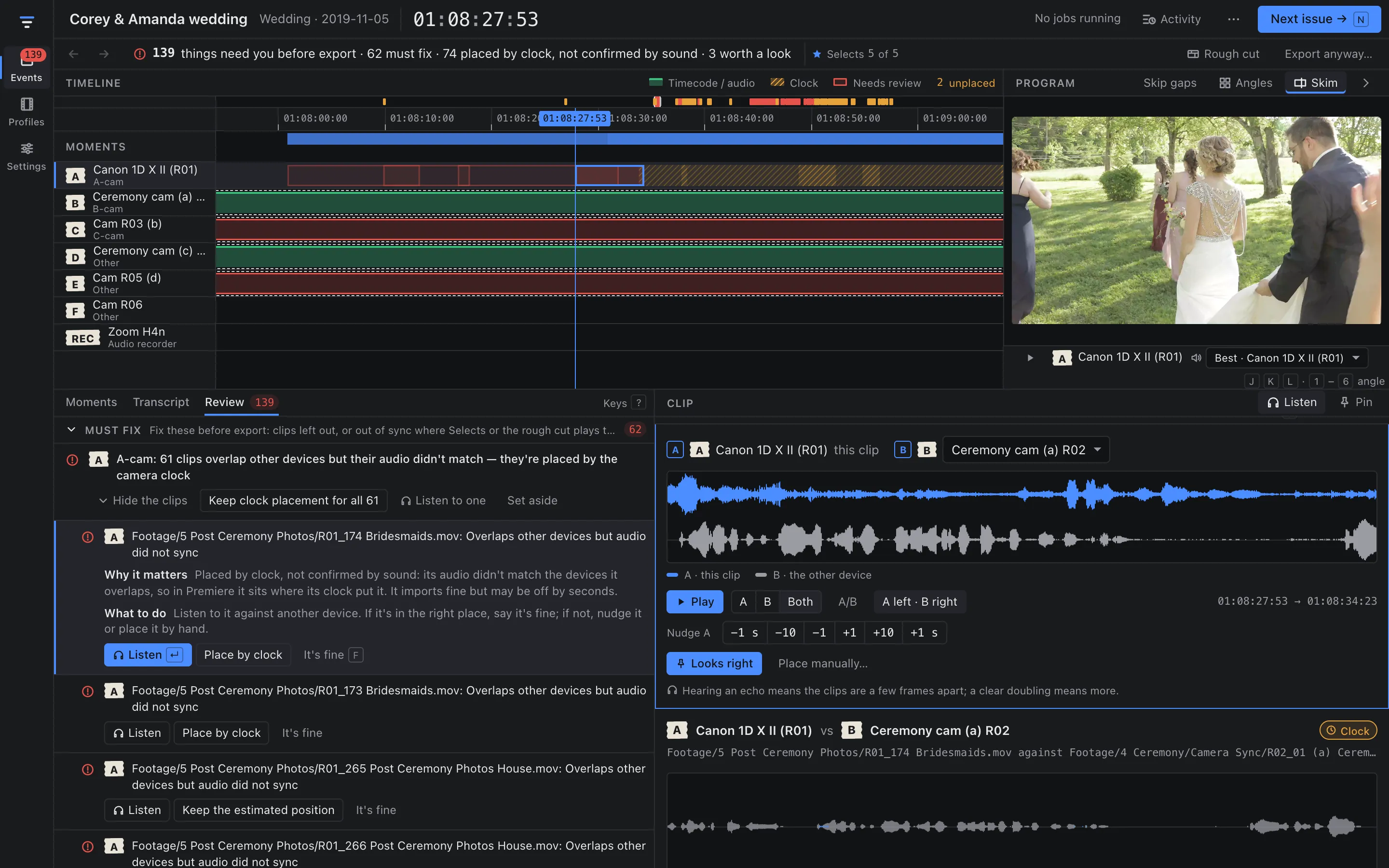
After the run, Sift tells you what needs you before the export is safe, and nothing else. “139 things need you before export · 62 must fix · 74 placed by clock, not confirmed by sound.” Press N for the next one.

Each item says why it matters and what to do. For a clip whose sound didn't match, press Enter to Listen: this clip against another device, A, B or both, left and right. Nudge by a frame, ten frames or a second, then “Looks right” pins it. Fixes for a whole camera take one click, and every change can be undone.

Review in the docs
The Review screen. At the top, the goal bar reads '139 things need you before export, 62 must fix, 74 placed by clock, not confirmed by sound, 3 worth a look'. A timeline shows seven device lanes. The Listen panel compares the A-cam clip with the B-cam as two waveforms, with Play, A, B, Both, nudge buttons and 'Looks right'.
Review · ListenA clip placed by its camera clock, checked by ear against the B-cam.

Multicam

Every angle under one playhead.

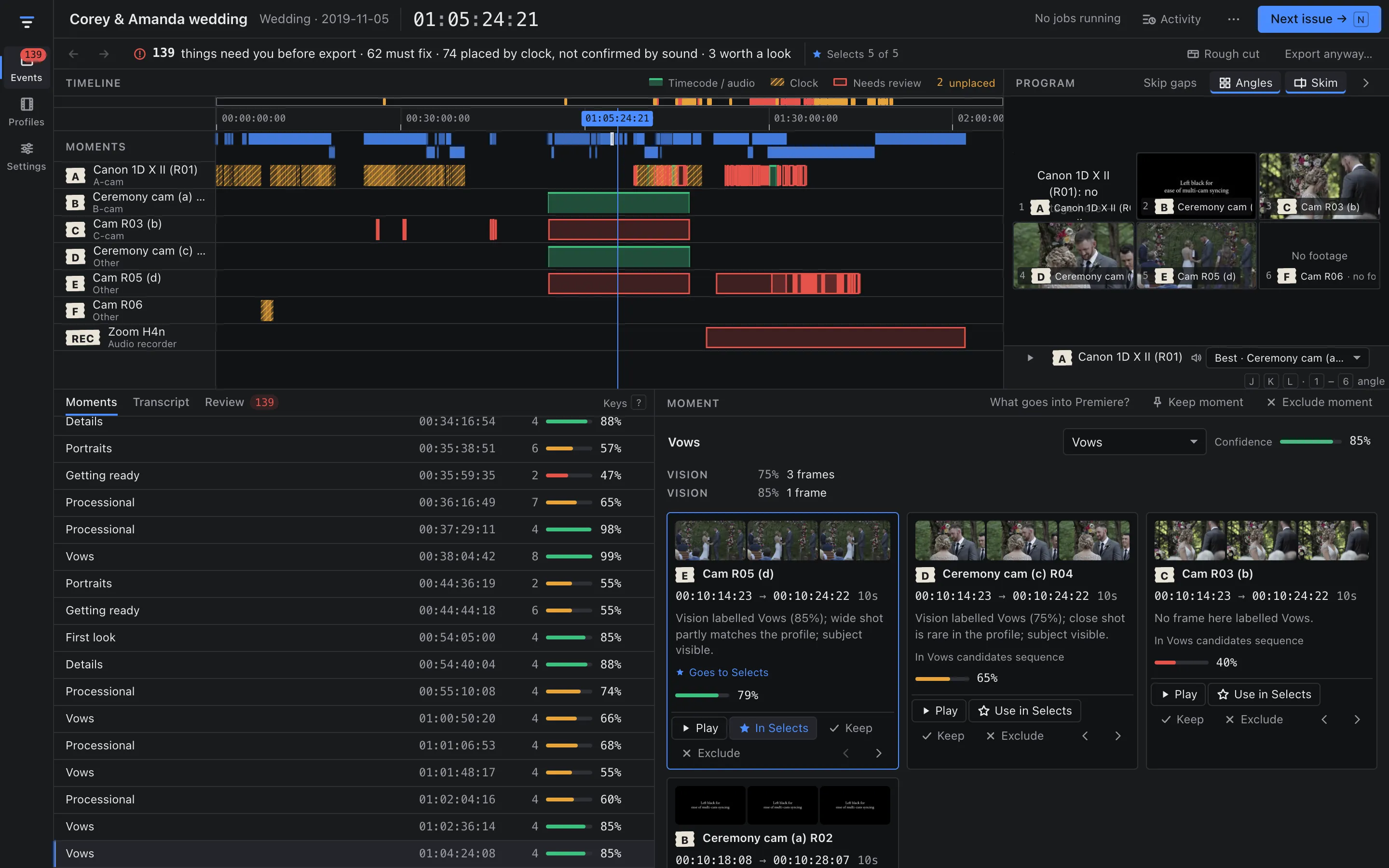
Every device sits in its own lane on one timeline, placed by timecode, by sound, or by clock. Scrub anywhere and the program monitor plays what was rolling. Turn on Angles to see every camera at the playhead, and press 1–9 to switch.

J K L shuttle, arrows step by frame or second, and ↑ ↓ jump between edits. Moments sit above the lanes. Each has candidates from different cameras: ★ Use in Selects, Keep, or Exclude.

The playhead and angles
The Review screen during the vows. The playhead sits at 01:05:24:21 across seven lanes. The program panel shows a grid of the six cameras at that moment. Below, the Vows moment lists candidates from Cam R05, Cam R04 and Cam R03, each with three frames, in and out timecodes, a reason and Play, Use in Selects, Keep and Exclude buttons.
Review · AnglesThe vows at 01:05:24:21: the angle grid, and the moment's candidates, one per camera.

Style match

Cut like the channel you point it at.

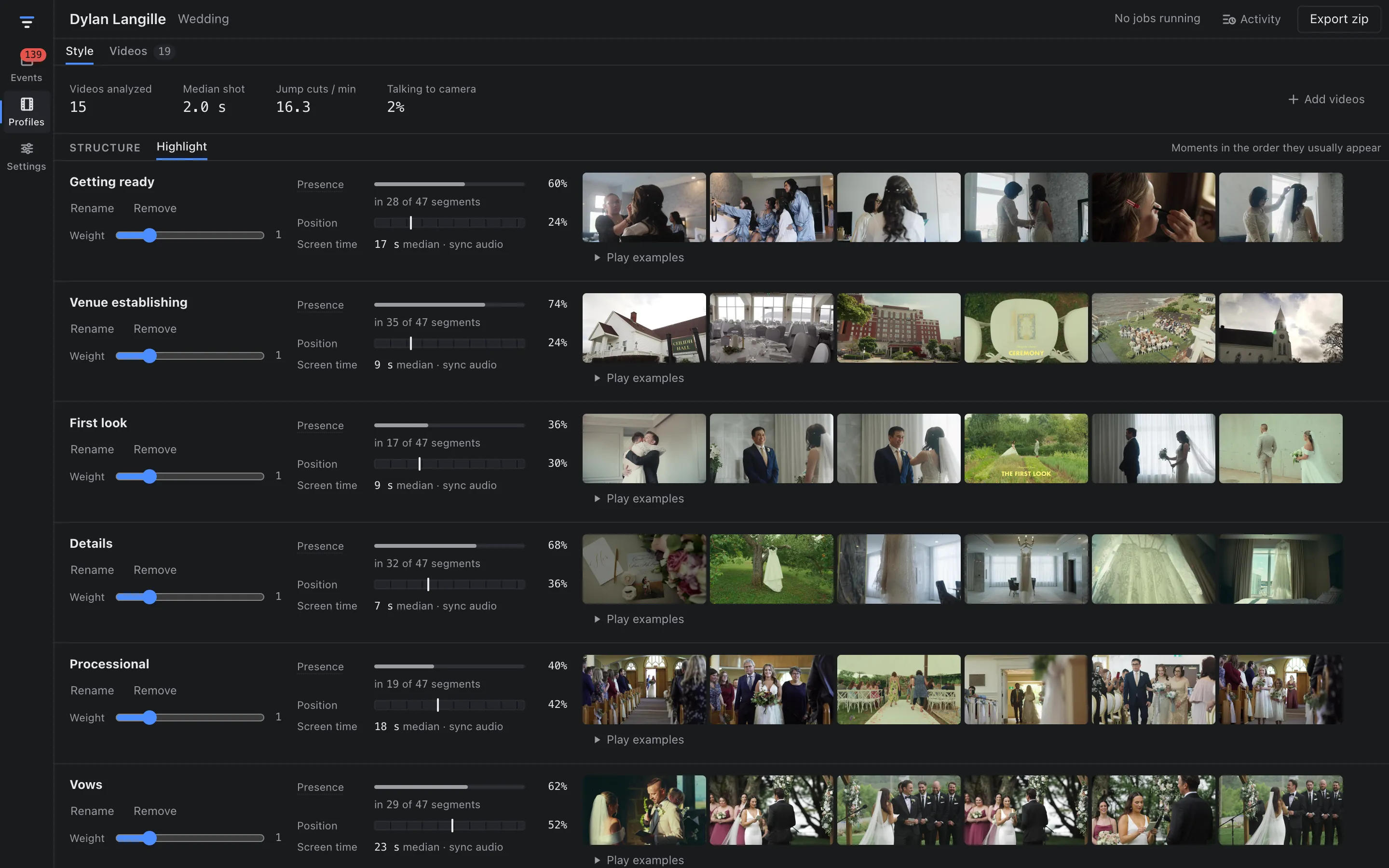
A style profile is measured from real videos: which moments appear and in what order, how much screen time each gets, median shot length, jump cuts per minute, how much is talking to camera, and whether a moment plays under its own sound.

The rough cut is planned to match, and the Style match panel shows how close it came, metric by metric, next to the channel's numbers. Dialogue is cut on word boundaries from the best source for it. Drop in a song and turn on Cut to music: the song sets the length, moments land on its sections, cuts snap to the beat, and the music ducks under speech.

Style profiles in the docs
A wedding style profile measured from 15 videos: median shot 2.0 s, 16.3 jump cuts per minute, 2 percent talking to camera. The Highlight structure lists moments in order: getting ready, venue establishing, first look, details, processional and vows, each with presence, position, median screen time and six example frames.
Style profileA wedding profile learned from 15 highlight films: 2.0 s median shot.

Premiere export

A project an editor can open and start cutting.

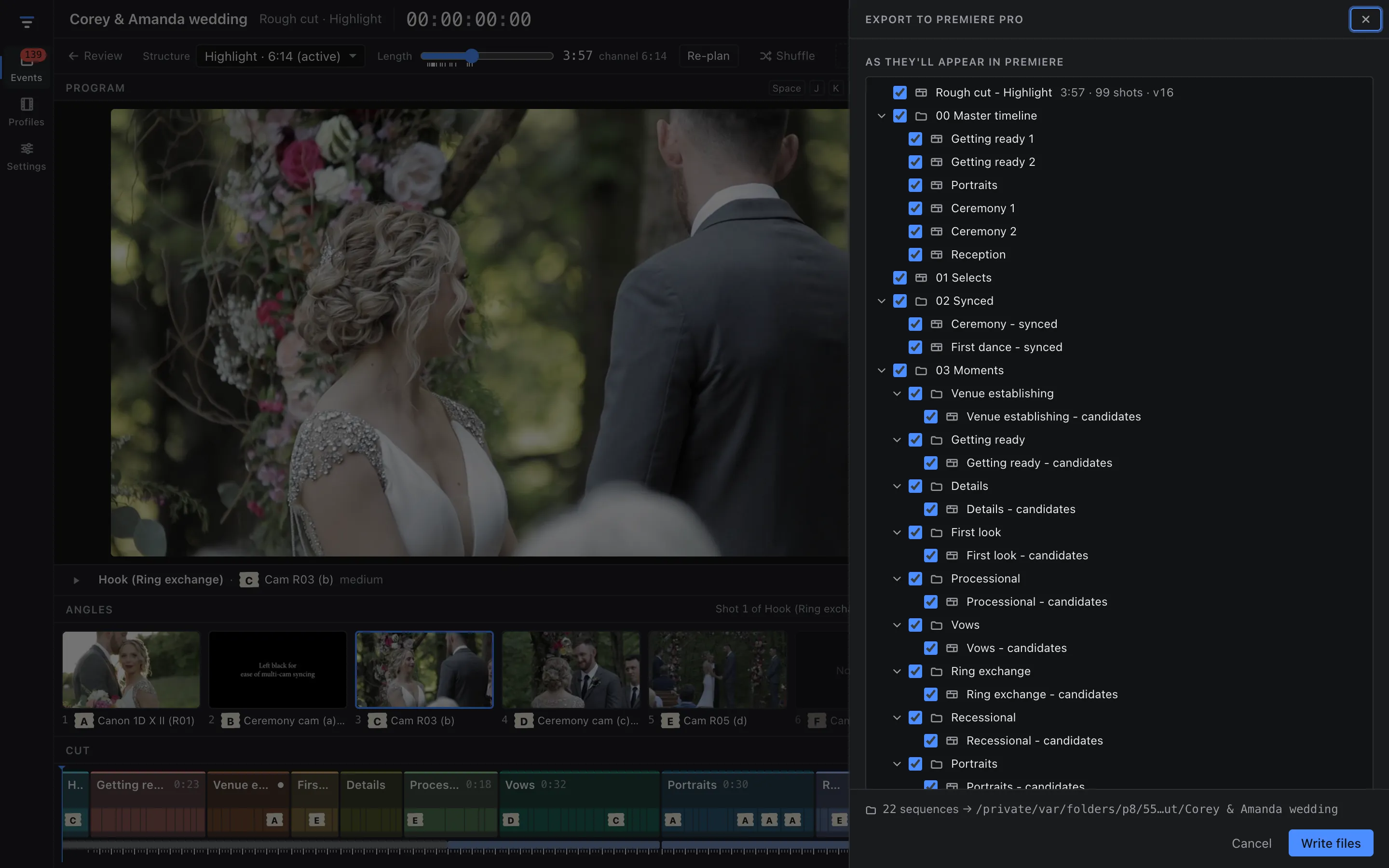
Export writes one Final Cut Pro 7 XML file for Premiere Pro. The rough cut comes first, then numbered bins: a master timeline per part of the day, Selects, synced multicam sequences, a candidates sequence for every moment type, the cameras, and anything still flagged.

Captions come as SRT files. Copy media collects the footage beside the project and checks every copy. An editor drive root rewrites the paths for the editor's drive, so the XML opens on their machine with nothing to relink.

Export in the docs
The Export to Premiere Pro sheet. A tree titled 'As they'll appear in Premiere' lists: Rough cut - Highlight, 3:57, 99 shots; 00 Master timeline with Getting ready 1 and 2, Portraits, Ceremony 1 and 2, Reception; 01 Selects; 02 Synced with Ceremony and First dance; 03 Moments with a candidates sequence per moment. Footer: 22 sequences, Write files.
Export to Premiere Pro22 sequences in numbered bins, rough cut on top.

Who it's for

Editors who get handed a drive.

Wedding and event filmmakers

Six cameras, a lav or two and a Zoom on the lectern. Sift syncs the ceremony and speeches by sound, names the parts of the day, and finds the processional, vows, ring exchange, kiss, toasts and first dance. The rough cut follows your own highlight films, or the house style you cut for.

YouTube editors

Vlogs, sports and golf channels with a main cam, body-mounts, drones and phones. Sift groups takes and picks the best one, finds A-roll and moments, and builds a cut paced like the channel: its shot length, its jump cuts, its talking-to-camera share. Short-form candidates and a vertical Selects bin come with the export.

Local first

Your footage stays on your Mac.

Sift runs on your Mac and opens in your browser from 127.0.0.1. Model calls go straight from your Mac to OpenRouter or Anthropic, on your key and your budget cap. We don't see your footage, your transcripts or your key.

Read the privacy page
Stays on your Mac
Footage and audio, the project database, transcription (Whisper), sync, sound cues, the exported XML and media copies. Your API key, in the macOS Keychain.
Sent to your AI provider
Sampled still frames at 512 px, transcript text, and the event and cast names you entered. For a profile, one frame per shot of the videos you chose.

Questions

Asked before the first card.

Does my footage get uploaded?

No. Your footage, audio and project files stay on your Mac. To label moments and learn a style, Sift sends small still frames (512 px on the long edge) and transcript text to the AI provider you choose, with your own API key. Audio is never sent: transcription runs on your Mac. The Privacy page lists exactly what leaves.

What footage can it read?

MP4, MOV, M4V, MXF, MTS/M2TS, AVI and MKV video; WAV/BWF, MP3, M4A and AIFF audio. It recognises Sony, Canon, GoPro, DJI and iPhone files, and Zoom, Tascam and Sound Devices recorders. Camera RAW (BRAW, R3D, ARW, CR3 and others) is listed as unsupported so you can see what was left out.

How does it sync cameras without timecode?

By sound. Sift compares each clip's audio with the devices it overlaps. Clips that match are placed to the frame. Clips that don't are placed by their camera clock and flagged in Review, where you can listen to them against another device and nudge or pin them.

What does the AI cost?

You pay your provider directly. A full run of a 436-file, seven-device wedding cost between $5.68 and $7.73 in our runs. Each event and profile has a budget cap, and Sift shows the estimate before it starts. See Pricing for the details.

Do I need Premiere Pro?

The export is a Final Cut Pro 7 XML file made for Premiere Pro, with bins, sequences, markers and captions. Sift doesn't need Premiere to run; you need it to open the project.

Does it copy another creator's videos?

No footage or music from the channel goes into your cut. A style profile is a set of measurements: which moments appear and in what order, how long shots run, how often the edit jump-cuts, how much is talking to camera. The rough cut is built only from your footage.

Can I use it offline?

Partly. With API calls switched off, scanning, sync, scene detection, transcription, takes and frame sampling still run. Moment labels and style profiles need the API.

Windows? Intel Macs?

No. Sift runs on Apple silicon Macs with macOS 13 Ventura or later.
Hand it the next card dump.

A license, plus your own AI key. You pay the model provider directly, usually a few dollars per event.

Download for MacBuy a license: coming soon